I remember the sinking feeling when my dishwasher suddenly refused to drain, leaving me staring at a puddle of soapy water. It was one of those mornings where I just wanted my trusty appliance to do its job, but instead, I was faced with a stubborn silence and a growing mess. That moment was a real lightbulb for me—if I wanted to fix my dishwasher myself, I needed to understand what was going wrong beneath the surface.
Why Diagnosing Your Dishwasher Matters More Than Ever
Knowing how to troubleshoot your dishwasher isn’t just about saving a few bucks on repairs. It’s about gaining independence, understanding your home appliances, and avoiding the frustration of waiting days for a technician who might overlook the simple fix. When I first started exploring DIY diagnostics, I made the mistake of assuming every problem was complicated. Turns out, many issues stem from a handful of common parts that you can inspect and replace yourself, often with just a few tools.
Getting familiar with the basics of dishwasher parts and how to identify faults is a game changer. It’s like having a secret code that unlocks the mystery of why your dishwasher isn’t running right. And trust me, once you get the hang of it, you’ll start seeing trouble spots before they turn into full-blown breakdowns.
If you’ve ever faced a dishwasher that leaks, doesn’t clean well, or just refuses to turn on, then you know how urgent it feels. But the good news is that most of these issues have roots you can trace back to specific parts—like the door latch, float switch, or pump. And for those who think DIY repairs are too complicated or risky, I can tell you from experience that most problems are straightforward once you understand what to look for.
In this guide, I’ll walk you through the essential diagnostics and give you tips on how to identify faulty parts quickly. There’s no need to guess blindly or shell out hundreds for a repair. Instead, you’ll learn how to spot the issues early, fix them with confidence, and keep your dishwasher running smoothly.
Before we dive into the nuts and bolts, tell me—have you ever faced a problem where your dishwasher just stopped working without warning? If yes, then you’re in the right place. And if not, trust me, it’s only a matter of time. Let’s get started on empowering you to take control of your appliance repairs.
Is DIY Dishwasher Repair Really Worth the Hassle?
When I first started out, I was skeptical. I wondered if I’d end up causing more damage or wasting time. But I learned that rushing to replace the entire dishwasher is often unnecessary. A simple diagnosis can save you money and frustration. Remember, even expert technicians rely on basic troubleshooting to pinpoint issues. You can do it too, especially if you familiarize yourself with common parts and faults. And if you want to get a head start, check out my recommended guide on Parts and Diagnostics for quick fault identification. It’s a resource I wish I had when I first started repairing my appliances.
Locate the Problem Area
Start by observing what isn’t working. Is the dishwasher not draining, not cleaning, or not turning on? For example, I once found my dishwasher wasn’t draining because I overlooked the clogged filter. Remove the bottom rack and inspect the filter and drain area for debris. If you’re unsure which part to check, visit Parts and Diagnostics for detailed guidance.
Check the Door Latch and Switch
The door latch acts like a gatekeeper; if it doesn’t lock properly, the dishwasher won’t start. To test it, close the door firmly and listen for a click. If it doesn’t latch, inspect the latch for damage or debris. You can also manually test the switch with a multimeter to see if it’s functioning correctly. Think of it like a light switch—if it’s broken, the circuit remains open, and the machine won’t run.
Test the Float Switch
The float switch is your dishwasher’s safety valve, preventing overflows. It floats on water and signals the machine to stop filling when water reaches a certain level. To test it, locate the float (usually a small dome or cylinder inside the tub), lift it gently, and listen for a click or check continuity with a multimeter. If it’s stuck or faulty, water may not fill or drain properly. For a visual guide, see Parts and Diagnostics. 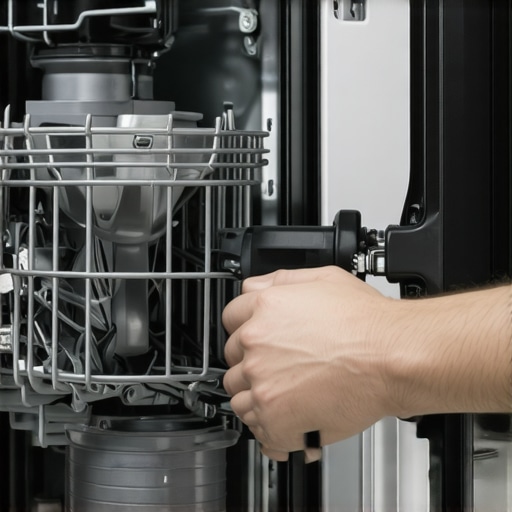
Evaluate the Pump and Motor
If your dishwasher fills but doesn’t drain, the pump or motor may be at fault. Listen for humming sounds during the drain cycle—if you hear nothing or a humming that doesn’t turn into noise, the pump could be jammed or broken. To inspect, remove the access panel underneath the dishwasher, and manually check if the impeller spins freely. Be cautious—electric parts can be dangerous. If the pump is seized or damaged, replacing it is straightforward if you follow a repair guide.
Inspect the Drain Hose and Filter
A clogged drain hose or filter can cause water to back up. Detach the hose from the sink or drain pipe and clear any obstructions. Similarly, clean the filter at the bottom of the tub. Think of it like cleaning a clogged artery—keeping the flow smooth prevents backups. Regular maintenance like this can prevent most drainage issues.
Use Diagnostic Tests to Confirm Faults
Many dishwashers have diagnostic modes you can activate by pressing specific button sequences. Refer to your model’s manual or visit Parts and Diagnostics to learn how to run these tests. They can quickly pinpoint issues like wiring problems or sensor failures, saving you time.
Order and Replace Faulty Parts
Once you identify the faulty part—whether it’s a door switch, float, pump, or filter—order a replacement. Follow your manufacturer’s instructions or consult a repair guide. Remember, many parts are designed for easy snap-in or screw-in replacement, making DIY repairs accessible. Always disconnect power before working on electrical components. With patience and the right tools, you can restore your dishwasher’s performance without calling a technician.Many DIY enthusiasts fall into the trap of oversimplifying dishwasher diagnostics, assuming that all faults are either obvious or require complex tools. In reality, some common misconceptions can lead to costly mistakes. For example, a widespread myth is that replacing a single faulty part always fixes the entire problem. While sometimes true, this approach can overlook underlying issues like wiring problems or sensor failures that aren’t immediately obvious. Make sure to double-check electrical connections and test sensors with a multimeter before ordering parts. Another common mistake is assuming that all dishwasher models share identical parts and repair procedures. In fact, minor differences in design can cause significant variations in diagnosis and repair. Always consult your specific model’s manual or detailed guides like Parts and Diagnostics to avoid incompatible replacements. \n\nLet’s address a question many advanced DIYers ask: How do I differentiate between a faulty sensor and a mechanical jam? Sensors often fail gradually, giving inconsistent signals, whereas mechanical jams usually cause abrupt stoppages. Using diagnostic modes or external testing tools can help pinpoint whether the issue stems from electrical components or physical obstructions. According to a study by the Appliance Repair Education Foundation, nearly 60% of appliance failures are related to sensor issues rather than major mechanical failures, emphasizing the importance of understanding these nuances.\n\nAnother hidden trap is neglecting routine maintenance, which can mask underlying problems. Regularly inspecting and cleaning filters, spray arms, and drainage pathways is critical. Overlooking these simple steps might lead you to replace expensive parts unnecessarily when a thorough cleaning would suffice.\n\nHave you ever fallen into this trap? Let me know in the comments. Remember, understanding the subtleties of dishwasher parts and diagnostics is what separates a quick fix from a costly mistake. Keep learning, stay cautious, and your dishwasher will thank you for it.Keeping your dishwasher in top shape requires more than just knowing the parts; it demands the right tools and maintenance routines. I personally swear by a few key pieces of equipment that make diagnostics and repairs much smoother, saving me time and frustration. First, a quality multimeter is essential. I prefer the Fluke 117, which provides precise readings of voltage, resistance, and continuity. It’s durable, easy to use, and crucial for testing switches, sensors, and motor circuits accurately. I always keep it handy when troubleshooting electrical faults, especially when checking components like door switches or sensors, which are often the culprits behind intermittent failures. For me, it’s a step above cheaper models because it offers reliability and clear readings, which are vital when diagnosing complex issues.
The Hardest Lesson I Learned About Dishwasher Repairs
One of the toughest lessons I learned was that sometimes, the simplest problems have the simplest solutions. It’s easy to get caught up in complex diagnostics, but often a clogged filter or a stuck float switch is the root cause, saving me from unnecessary parts replacements.
Another insight was that patience is key. Rushing into repairs without thorough testing can lead to more damage. Taking my time to check each component carefully has saved me money and headaches.
Lastly, I realized that understanding the repair process deeply makes me more confident. Watching detailed guides and learning from mistakes turned me from a novice into someone who can troubleshoot most dishwasher issues effectively.
My Essential Toolkit for Dishwasher Repairs
- A quality multimeter, like the Fluke 117, for electrical testing
- A set of screwdrivers and pliers for disassembly and assembling
- Replacement parts from trusted sources, such as OEM suppliers
- Carefully curated repair guides and videos specific to my dishwasher model
These tools and resources have become my go-to arsenal for tackling dishwasher problems efficiently and safely.
Don’t Hesitate to Take Action
Your dishwasher can be a reliable helper, but it’s also a machine that benefits from your attention and care. With the right knowledge and tools, you can fix many issues yourself and extend its lifespan. Remember, every repair is a step toward greater confidence and independence in managing your home appliances.
What’s the most frustrating dishwasher problem you’ve faced, and how did you handle it? Share your experiences below!